A drone recording can show where someone walked, when a vehicle moved, or what happened before patrol officers arrived. Understanding its significance in a criminal case requires connecting those images to a reliable sequence of events.
Frisco Police operates a Drone as First Responder program. According to the department’s technology transparency page, drones often reach incidents before ground units, and pilots relay information to responding officers.
For someone facing an investigation, Frisco drone evidence therefore raises several distinct questions: when recording began, whether the relevant person remained visible, how timestamps compare with other records, and what information officers received before acting.
Identify What the Drone Actually Recorded
Begin with the recording’s scope. A launch time, arrival time, and recording start time may describe different events. Ask which one appears in each document.
Also establish whether the material being reviewed is a saved video, a live-feed screen recording, an exported excerpt, or a still image. A selected clip may show the disputed conduct clearly while leaving its surrounding circumstances unresolved.
Frisco provides a public flight dashboard, but a flight listing should be treated as a lead for identifying records. Do not assume it contains the underlying footage, radio communications, or every item associated with an investigation. The department describes its dashboard as a public record of flights.
Ask counsel to identify the recording’s beginning and end, the location covered, and any additional files associated with the same incident.
Build the Sequence From Several Sources
Organize the investigation around specific milestones:
- When the initial call or officer request was made.
- When the drone launched and first obtained a relevant view.
- When the pilot reported a person’s location or conduct.
- When officers arrived, approached, detained, or arrested someone.
- When recording ended or responsibility for observation changed.
For each milestone, identify the supporting source. A dispatch entry, pilot report, video frame, and body-camera recording may describe related events from different perspectives.
Keep observations separate from interpretations. “A person walked behind a building” records visible movement. “The suspect escaped behind the building” adds conclusions about identity and purpose that may require other evidence.
This comparison also helps a lawyer distinguish information communicated during the response from details identified only during later video review.
Verify What Each Timestamp Means
Numbers displayed on a recording can appear precise without explaining their source. Ask whether they represent capture time, elapsed playback time, or information added during export. Confirm the time zone and whether any clock adjustment has been documented.
Forensic video guidance hosted by NIST identifies recording-device time offsets, device settings, and recovery documentation as potentially relevant to an examination. It also addresses changes to metadata that can occur during video conversion.
A discrepancy should be investigated before anyone simply shifts one recording to match another. An examiner can look for a shared event, such as a vehicle entering both camera views, and explain whether it provides a dependable comparison point.
Frame timing deserves separate attention when a claim depends on fractions of a second. SWGDE’s 2022 frame-timing guidance explains that reported frame rates and individual frame intervals require careful examination; the displayed playback rate alone may not answer an elapsed-time question.
Examine Breaks in Visibility
Even an uninterrupted recording can contain a break in observation. A person may pass beneath a roof, behind a tree, or outside the camera’s view. The relevant question is what supports linking the person seen afterward to the person seen before.
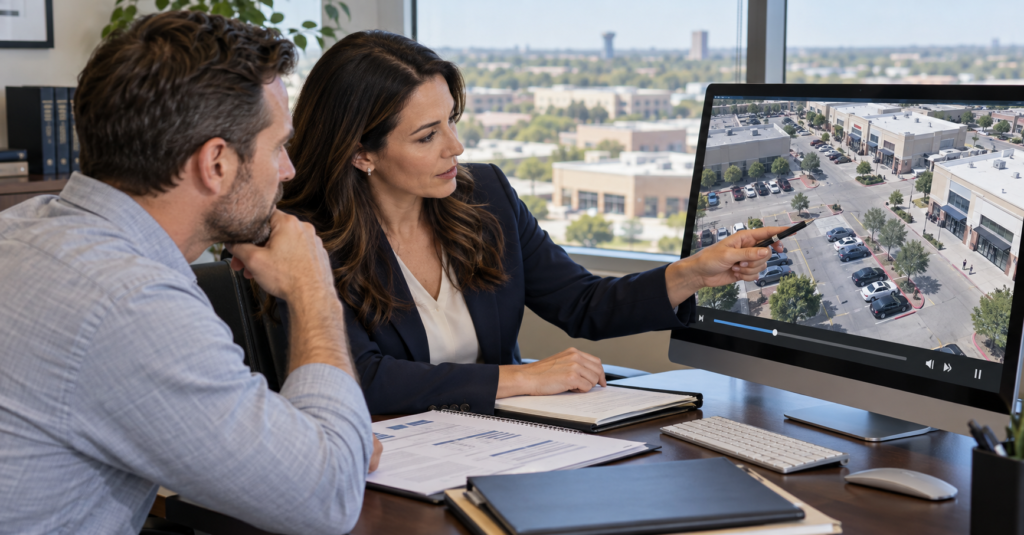
Consider a hypothetical parking-lot investigation. A drone records someone in a dark jacket walking behind a shopping center. Twenty seconds later, someone wearing similar clothing appears near another entrance and is stopped by officers.
The footage would require closer review: was there continuous observation from another camera or officer? Were other people present? Did the pilot report losing sight of the person? What details supported the identification?
A gap does not establish that officers stopped the wrong person. It identifies a point where the evidence connecting two observations needs examination.
Record uncertainty accurately. Avoid turning a possible match into a definite identification—or treating an unobserved interval as proof that nothing happened.
Preserve the Files Needed for Meaningful Review
Tell defense counsel promptly if drone footage may be relevant. A preservation request can identify the incident, approximate time range, location, and categories of records that may need protection from routine deletion.
Depending on what exists and is relevant, counsel may seek:
- The original or best available recording and associated metadata.
- Flight and recording logs, including start and stop information.
- Dispatch records and communications between the pilot and ground officers.
- Related body-camera or vehicle-camera footage.
- Records explaining how a video was exported, shortened, or otherwise processed.
These are possible evidence categories, not a promise that every system creates every record.
SWGDE’s frame-timing guidance cautions against using transcoded or screen-captured files for that specific analysis. A convenient viewing copy may therefore be insufficient when precise timing is disputed.
Confirm the applicable retention rules. Frisco’s drone FAQ refers to Texas law and department policy without stating a single fixed retention period for all drone recordings.
If you already possess relevant footage, preserve the received file and accompanying messages. Keep any annotations or demonstration edits in separate working copies.
Use Criminal Discovery to Seek Case Evidence
A public dashboard or records inquiry does not replace the criminal discovery process.
Under Article 39.14 of the Texas Code of Criminal Procedure, a timely defense request triggers production obligations for specified material evidence within the state’s possession, custody, or control, subject to statutory restrictions. The article also requires disclosure of qualifying exculpatory, impeachment, and mitigating information.
A focused request can identify the missing period or record instead of asking vaguely for “everything from the drone.”
For example, if a report describes continuous tracking but the provided clip begins immediately before detention, counsel can ask about earlier footage, communications, and records explaining the clip’s boundaries.
Preservation and production serve different purposes: one seeks to keep material available, while the other seeks access through the appropriate process. A lawyer can address both and follow up on incomplete responses.
Understand What a Timeline Problem Can Mean in Court
Texas Rule of Evidence 901 requires sufficient support for finding that evidence is what its proponent claims. For video, that can make the source, recording process, and supporting testimony important. Rules 106 and 107 also address circumstances in which additional material is needed to understand an excerpt fairly.
The legal effect of a timing problem depends on its significance and the supporting evidence. An explained clock offset may permit a reliable comparison. An unresolved gap may limit what a witness can confidently say.
A copy is not automatically inadmissible simply because it is a copy; Rule 1003 generally permits duplicates, subject to authenticity and fairness concerns.
Counsel can evaluate whether the issue calls for additional discovery, expert analysis, cross-examination, or an evidentiary objection. For broader context, see what evidence can be used in a criminal case.
When to Contact a Frisco Criminal Defense Lawyer
Seek advice when police mention aerial surveillance, a report relies on a drone pilot’s observations, or video appears central to a proposed plea agreement.
Frisco Police’s Criminal Investigations Division works with both the Collin County and Denton County district attorney’s offices. Confirm which county and court are handling the particular case rather than assuming every Frisco investigation follows the same local process.
Bring the case number, paperwork already received, and a short account of the disputed event. Clearly distinguish what you personally remember from what you learned by watching a recording or reading a report.
A defense lawyer can identify the relevant records, address preservation, and decide whether a qualified forensic video examiner would help. The useful question is specific: can the available evidence reliably establish the sequence, identity, or action being alleged?
Note: This article is for general informational purposes only and does not constitute legal advice. Texas law, court rules, and police retention policies may change. Consult a qualified Texas criminal defense attorney about the evidence, deadlines, and legal options in your case.