
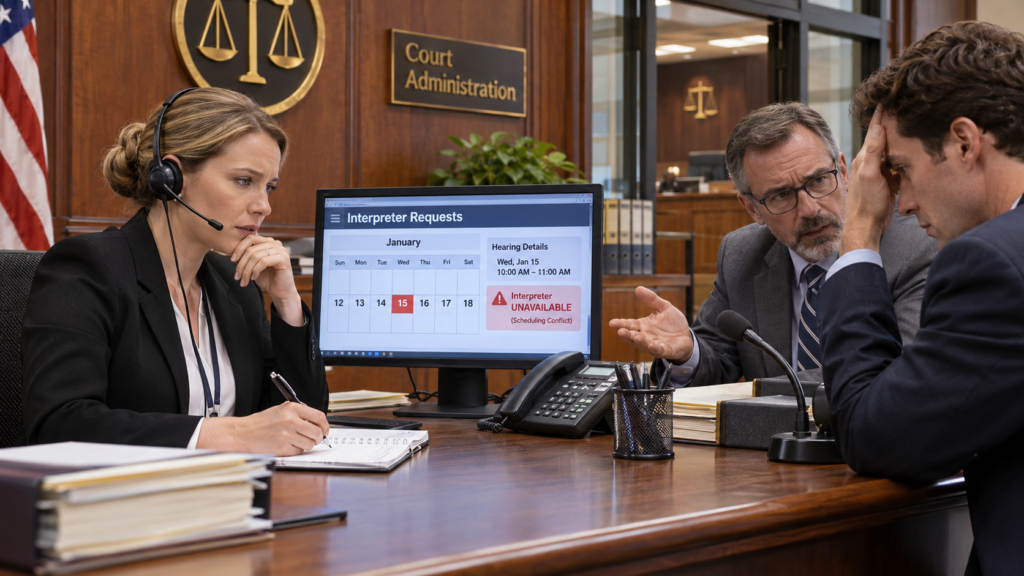
A court employee says an interpreter will be arranged. You write down the hearing date, organize transportation, and assume everything is ready. When you arrive, courtroom staff cannot find the request.
Court interpreter requests can encounter problems between the initial conversation and the hearing itself. A missing form, changed courtroom, or unreported postponement can leave someone struggling to understand a proceeding that affects important rights.
The practical task is to establish what assistance is needed, who is arranging it, and which appearance the arrangement covers. This guide uses United States court examples; requirements vary by jurisdiction, court, and case type.
Identify the Correct Request Process
Start with the court named on your hearing notice. Find its official language-access or accessibility page and identify the person responsible for requests.
For spoken-language interpretation, this may be an interpreter coordinator, language-access representative, or courtroom clerk. Disability-related communication assistance may follow a separate accommodation process.
Responsibility for arranging and paying also varies. For example, the federal Northern District of California explains that parties generally arrange and pay for interpreters in most civil cases unless the court orders otherwise. Do not assume that another court’s practice applies to your proceeding.
For state and local courts covered by ADA Title II, disability-related communication assistance involves effective-communication obligations. Depending on the person’s needs, assistance may include a qualified sign-language interpreter, real-time captioning, or another appropriate aid. Deaf and hard-of-hearing people do not all use the same communication method.
Describe the assistance you actually need rather than relying on a general request for “translation.”
Give Enough Information to Arrange the Right Assistance
A request should identify both the court event and the person needing assistance. Have these details available:
- Case name and number.
- Hearing date, time, courthouse, and courtroom or department.
- Whether participation will be in person, remote, or hybrid.
- Name and role of each person needing interpretation.
- Requested language, relevant dialect, or communication method.
- Contact information for follow-up.
Identify witnesses separately. California’s civil interpreter request form, for example, instructs users to complete a separate form for each witness needing language assistance.
If the court requests an estimated hearing length, distinguish a brief scheduling appearance from a hearing involving testimony. Ask your lawyer or the clerk how to provide that estimate if you are unsure.
Use the court’s required submission method. Sending an email to a general information address may not complete the published request process.
Confirm Approval, Not Just Receipt
An automated submission receipt establishes that information was transmitted. It may not establish that the request was approved or that assistance has been arranged for the hearing.
The California Courts interpreter request guide specifically recommends contacting the appropriate coordinator to confirm receipt and approval. It also directs users to check local submission requirements and advance-notice periods.
Ask a focused question: “Has interpretation been arranged for this person, in this language, for this hearing?”
Keep the submitted form, acknowledgment, and any approval together. If confirmation comes by telephone, record the date, staff member’s name, and information provided. Ask whether written confirmation is available.
Clarify how you will learn about a problem. Some arrangements may remain subject to interpreter availability, so ask when to follow up and whom to contact if no update arrives.
Recheck Arrangements When the Hearing Changes
A change in the court calendar creates a separate coordination task. Do not assume that a new hearing notice automatically updates every interpreter arrangement.
Notify the designated contact when the date, start time, location, participation method, or person attending changes. Ask whether the original request should be amended, canceled, or replaced.
Local cancellation requirements can matter. Monterey County Superior Court, for example, directs users to cancel interpreter requests with specified court staff when the associated hearing or service is canceled or postponed. Its published procedure includes an advance-notice requirement.
If you have a lawyer, establish who will handle this communication. A simple division of responsibility helps: counsel reports court scheduling changes, while you promptly report changes in your own attendance or communication needs.
Keep the latest confirmation with the current hearing notice.
Check What the Interpreter’s Assignment Covers
An interpreter arranged for courtroom proceedings may not also be available for a lengthy private meeting with your lawyer, mediation, or document preparation.
The federal District of Columbia’s interpreter guidance distinguishes courtroom coverage from separate attorney-client meetings. It explains that brief discussions around a hearing may depend on the schedule, while other meetings require additional arrangements.
Ask about any assistance you need before, during, and after the hearing. Written document translation should be discussed separately; do not assume every exhibit will be translated because a courtroom interpreter is present.
Court interpreters communicate what participants say and remain impartial. They do not provide legal advice or advocate for a party, as the Northern District of California explains.
Prepare questions about strategy with your lawyer rather than expecting the interpreter to answer them.
Avoid Relying on an Unapproved Substitute
A bilingual friend or signing relative may help with everyday communication without being equipped to interpret testimony accurately and impartially.
Before arranging a substitute, ask what qualifications and court approval are required. Certification requirements differ, and the relevant question is whether the proposed interpreter satisfies the rules for that proceeding.
For disability-related communication under the ADA, covered entities generally cannot require someone to bring a companion to interpret. Reliance on accompanying adults is limited, and children face still narrower exceptions. The Department of Justice emphasizes accuracy, impartiality, and the ability to handle specialized vocabulary.
Explain any concern about a substitute’s skills or conflict of interest to court staff and, when appropriate, the judge.
Prepare for the Interpretation Setup in a Remote Hearing
Joining the video hearing does not necessarily connect you to interpretation.
Ask whether the court uses a language channel, a separate telephone connection, or another setup. California Courts provides different connection guides for different platforms, including arrangements using two devices when built-in interpretation is unavailable.
Before the hearing, check:
- Whether your device supports the required interpretation features.
- How to select the correct language or view the sign-language interpreter.
- Who to contact if the connection fails.
- How to tell the court that you cannot hear, see, or understand the interpretation.
Use any available practice session. Test sound, camera position, internet access, and charging arrangements.
For sign-language interpretation, consider whether your screen allows a clear view while documents are displayed. Raise practical limitations early so the court can consider a workable arrangement.
Raise Missing or Inadequate Interpretation Immediately
If assistance is unavailable when you arrive, show staff your request and confirmation. Ask them to contact the interpreter coordinator or accessibility contact.
If the hearing begins and you cannot understand, tell the judge promptly. California Courts expressly advises participants to speak up when they cannot hear or understand the interpreter.
Describe the problem specifically: the language is incorrect, the sound cuts out, or the interpretation is not understandable. Ask the court to address it before continuing with substantive questions.
Do not assume that an interpreter problem cancels your appearance. Seek directions from the court about attendance and any requested postponement. Likewise, arranging interpretation should not replace reviewing the response obligations explained in our guide to what happens after you are served with legal papers.
When to Contact a Lawyer
Contact a lawyer when interpretation problems threaten your ability to testify, understand an agreement, or participate meaningfully in a hearing.
Legal help is particularly useful if a request is denied, the court proposes to proceed despite a serious communication problem, or an earlier hearing has already taken place without adequate assistance.
Bring the hearing notices, request forms, correspondence, and a factual account of what happened. A lawyer can assess available objections, postponement requests, accommodation review procedures, and any deadlines for challenging an order.
Note: This article provides general legal information, not legal advice. Interpreter eligibility, costs, request procedures, and remedies vary by court and case. Check your court’s official instructions and, where relevant, the Department of Justice’s effective-communication guidance.