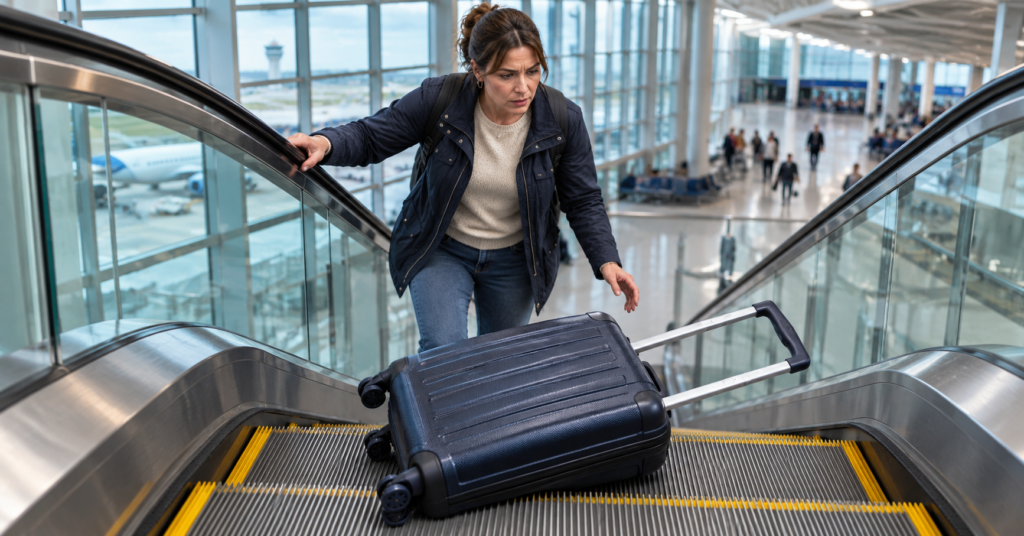
A suitcase slipping from someone’s grip can strike a passenger several steps below before that person has time to react. On a moving escalator, the initial impact may lead to further falls while nearby travelers try to help.
Detroit airport escalator falls involving luggage raise questions about the bag’s movement, the people involved, and the equipment’s condition. At Detroit Metropolitan Airport (DTW) in Romulus, evidence may become harder to gather once witnesses board flights and the injured person continues travelling. A useful claim assessment starts with reconstructing the event and identifying whose conduct or responsibilities require investigation.
Get Medical Help Before Continuing Your Journey
Tell airport staff that someone has been injured and request assistance. For an emergency, call 911. The airport police department also lists non-emergency dispatch at 734-942-2222, option 2. Ask for the incident number and the responding officer’s details when practical.
Describe whether the suitcase struck you, whether your head hit a step or landing, and whether you fell more than once. Do not let pressure to catch a flight replace a medical assessment when you have concerning symptoms.
The CDC notes that concussion symptoms can appear hours or days after an injury. Worsening headache, repeated vomiting, increasing confusion, or difficulty staying awake after a head injury require urgent medical attention.
If you initially felt well but later developed symptoms, explain that sequence accurately to your clinician.
Pinpoint the Escalator and the Sequence of Events
“An escalator near security” may be too vague to identify the relevant footage or maintenance records.
As soon as you can, record:
- The terminal, floor, and nearby signs, gates, or businesses.
- Whether the escalator was travelling up or down.
- Your approximate position when the bag struck.
- Where the suitcase started and where it stopped.
- Whether the escalator stopped, and when.
- The incident time, using Detroit local time.
Keep your boarding pass, itinerary, and timestamped messages. They can help narrow the search window, particularly if your phone later changes time zones.
Separate what you witnessed from what someone told you. Seeing a suitcase hit a passenger does not necessarily mean a witness saw how its owner lost control.
Identify the Traveler Without Creating Another Safety Problem
If circumstances allow, ask the person handling the luggage for their name and contact information. Request witness details too, including from anyone who saw what happened before the impact.
Do not chase someone through a terminal or physically prevent them from leaving. Give available descriptions and identifying information to the responding officer.
A useful witness account may explain whether the bag was unattended, whether its owner was struggling to manage several items, or whether another person bumped into it. Those details help distinguish careless handling from other possible causes.
If the traveler leaves unidentified, tell a lawyer promptly. Available footage, incident records, and lawful requests for information may provide leads, but identification is not guaranteed. Avoid publishing accusations or images naming a person whose involvement has not been established.
Request Records and Preserve Footage Separately
The airport authority directs requests for police-report copies through its Freedom of Information Act process. Written requests must identify the records sought and include the requester’s contact information. Specify the incident number, location, date, and a focused time range.
Ask counsel about a separate preservation request for relevant video and incident materials. A request for a report should not be treated as confirmation that every relevant recording has been preserved.
Identify the area where the bag began moving as well as the impact location. Footage showing only the aftermath may not explain why the suitcase fell.
Camera coverage, retention, and disclosure can vary. Do not assume footage exists, is still available, or will be released without restrictions.
Our guide to evidence that helps support a personal injury claim explains how recordings, witness accounts, and documents can work together.
Determine Whether the Problem Was Conduct, Equipment, or Both
A negligence claim generally requires establishing a duty, a breach of that duty, a causal connection, and resulting harm. The fact that someone was injured does not establish every element.
An investigation may follow several paths:
- Luggage handling: What did the traveler do, and was reasonable care used?
- Equipment condition: Was there an actual defect or unusual movement that contributed to the fall?
- Responsibility for the premises: Which entity possessed or controlled the relevant area, and what duties followed?
A 2025 unpublished Michigan appellate decision involving a DTW escalator fall examined the distinction between ordinary negligence and premises liability, including possession and control. It illustrates why an airport-related contract or company name alone does not resolve responsibility.
If a defect is suspected, counsel may seek inspection records, repair history, earlier complaints, and expert analysis. A bag striking someone on an otherwise functioning escalator requires a different factual inquiry.
Evaluate Warning Signs and Comparative Fault Carefully
An insurer may question whether the injured passenger was holding the handrail, watching the steps, or carrying excessive luggage. Those allegations should be tested against the actual sequence and available evidence.
In Michigan premises-liability cases, the Supreme Court’s decision in Kandil-Elsayed places the open and obvious nature of a condition within the analysis of breach and comparative fault, rather than treating it as automatically eliminating the land possessor’s duty. This does not guarantee recovery.
Michigan’s comparative-fault statute generally reduces damages according to the injured person’s share of fault. If that share exceeds the combined fault of the others involved, noneconomic damages are barred, while economic damages are reduced.
A warning sign or a momentary distraction should therefore be assessed in context, including whether it actually contributed to the injury.
Connect Treatment and Financial Losses Across Locations
A traveler might receive airport assistance, visit an emergency department after landing, and obtain follow-up care in another state. Keep those records together so the treatment timeline remains understandable.
The airport fire department provides a separate authorization process for requesting medical records when it supplied medical services. A police report is not a substitute for that treatment record.
Retain medical bills, prescription receipts, treatment-related transport costs, and records of missed work. Describe practical limitations such as difficulty lifting, walking, sleeping, or performing job duties.
Record any earlier condition honestly and explain what changed after the fall. Receipts for disrupted travel may also be worth retaining, although reimbursement depends on causation, the applicable claim, and available coverage.
Check Filing Deadlines and Governmental Notice Requirements
Michigan generally provides three years for personal-injury actions under MCL 600.5805, subject to exceptions and other applicable requirements. That period should not be treated as permission to postpone investigating a claim.
Claims against a governmental airport authority require additional analysis. Michigan law generally protects governmental agencies performing governmental functions unless an applicable exception permits liability.
For example, the public-building exception contains a 120-day notice requirement, with specified information about the defect, injury, location, and known witnesses. Whether that exception applies to a particular escalator incident requires legal review.
A customer-service complaint, police report, or records request should not be assumed to satisfy formal legal notice requirements. Counsel should identify the correct recipient, method of service, and deadline.
When to Contact a Lawyer
Contact a Michigan personal injury lawyer promptly when an escalator incident causes significant injury, the luggage owner remains unidentified, or responsibility is disputed.
Bring your itinerary, incident number, photographs, witness contacts, and medical information. Mention any conversations with airport personnel or insurers, including requests for recorded statements or signed releases.
A lawyer can assess which parties have a potential legal duty, seek relevant records, evaluate available insurance, and address any notice obligations. If you live outside Michigan, explain where treatment is continuing so records and communications can be coordinated.
Before accepting a settlement, understand which claims the release would resolve and whether the medical consequences have been adequately evaluated.
Note: This article provides general information about Michigan personal injury law and is not legal or medical advice. Liability, deadlines, and available compensation depend on the circumstances. Consult a Michigan-licensed attorney about a specific claim.