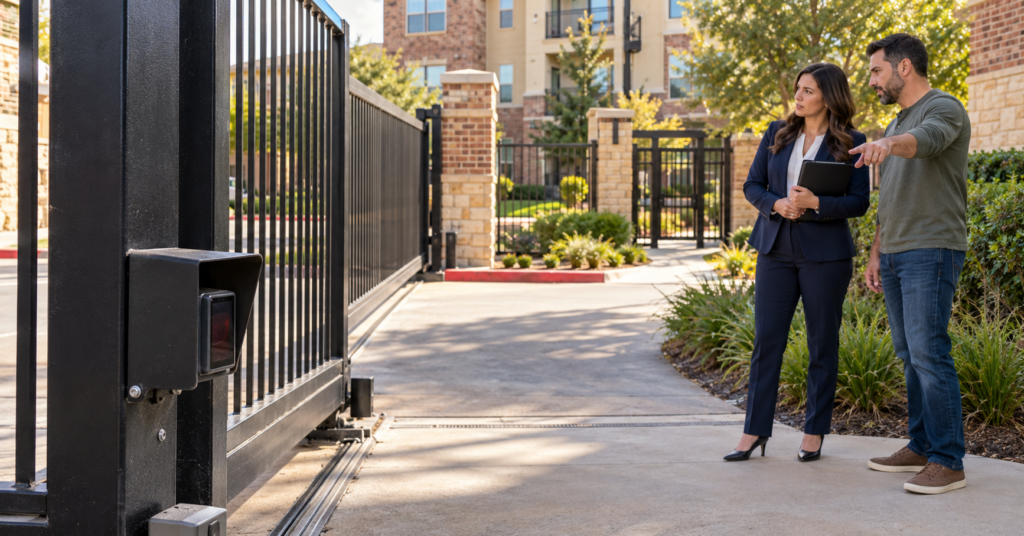
Fort Worth apartment gate injuries can leave residents and visitors facing medical bills, missed work, and uncertainty about who was responsible. When an automatic gate strikes or traps someone, the first explanation may be that the person walked too close or that the gate had always worked normally.
A useful investigation looks beyond those initial accounts. It examines the equipment, pedestrian access, earlier warning signs, and the parties responsible for the entrance. An injury alone does not establish negligence, and a gate that opens and closes is not necessarily operating safely.
Get Help Without Recreating the Accident
Move away from the gate if you can do so safely and seek appropriate medical care. Call 911 if someone is trapped or seriously injured. Tell responders that powered equipment is involved.
Do not place a hand, foot, or another person in the gate’s path to see whether it reverses. Avoid opening control cabinets, changing settings, or attempting repairs. Those actions can create another injury and alter conditions that may need professional examination.
Notify apartment management and describe the location and immediate hazard. Keep a copy of your written report, but do not delay emergency assistance while trying to complete the property’s incident paperwork.
Understand What the Safety Devices Are Supposed to Do
Automatic vehicle gates may use several forms of entrapment protection. These can include photoelectric devices that detect an obstruction without contact, pressure-sensitive edges, and protection built into the gate operator. The appropriate arrangement depends on the equipment and installation. UL’s gate-operator guidance describes these different protective methods.
The important question is whether the relevant protection functioned where the injury occurred. A sensor at one location does not establish that every moving edge or trapping point was protected.
An investigator may need to distinguish an absent device from one that was damaged, disconnected, incorrectly positioned, or unsuitable for the installation. A photograph showing a sensor housing cannot answer all those questions.
Similarly, a keypad successfully opening the gate shows that an opening command was received. It does not demonstrate that the system would detect a person in a hazardous position.
Examine the Separate Pedestrian Entrance
The route available to someone on foot can be important. Gate-manufacturer safety guidance recommends separate pedestrian access so people do not have to cross the path of a moving vehicle gate.
Document whether the apartment complex had a pedestrian gate or walkway and whether it was usable at the time. Relevant circumstances might include a broken latch, an inaccessible entry device, a blocked path, or instructions directing visitors toward the vehicle entrance.
Consider a hypothetical resident who reports that the pedestrian gate cannot be opened and later uses the driveway entrance. Investigators would want to understand the access problem, what management knew, and exactly how the injury happened. That scenario does not establish liability by itself.
Record the arrangement honestly, including visible warning signs and available alternatives. Do not assume that having used the driveway entrance previously made it safe to approach a moving gate.
Preserve the Scene and Digital Records
Once immediate safety needs are addressed, collect information from a safe location. Photographs can show the gate’s position, surrounding fencing, warning signs, pedestrian route, and the area where contact occurred. Identify the specific entrance when a property has more than one.
Write down the approximate time, direction of movement, what activated the gate if known, and whether anyone witnessed the incident. Separate what you personally observed from what someone else later told you.
Potential records include:
- Surveillance footage covering the approach, impact, and immediate response.
- Earlier maintenance requests, resident complaints, inspection reports, and repair invoices.
- Gate model information, service records, and access or fault logs if the system retains them.
Ask promptly for relevant material to be preserved. A lawyer can help direct preservation requests to the parties holding it and address an inspection before equipment is altered. Necessary steps to protect people should not be delayed.
Our guide to evidence that can support a personal injury case explains how medical records, witness information, and other documentation can complement the scene evidence.
Establish What the Responsible Party Knew
For a Texas premises-liability claim brought by an invitee, the legal issues generally include an unreasonably dangerous condition, the defendant’s actual or constructive knowledge, a failure to exercise reasonable care, and a causal connection to the injury. The person’s legal status and circumstances affect the duty owed.
Earlier complaints may help establish knowledge, but their content matters. A report that a remote control stopped working describes a different problem from a report that the gate struck someone or failed to reverse.
Useful questions include when the specific problem was first reported, who received the report, what inspection followed, and whether repairs addressed that problem. A service ticket marked completed may need to be compared with the technician’s actual findings.
Known or obvious hazards can also affect a landowner’s duty under Texas law, subject to exceptions. A lawyer should assess those issues rather than assuming every gate accident presents the same claim.
Identify Who Controlled and Serviced the Gate
The apartment’s public name may differ from the legal names of its owner, management company, and maintenance contractor. Investigation should establish their roles at the time of the incident.
Texas premises-liability analysis can turn on control over the relevant property or condition. The Texas Supreme Court has addressed how a contractor’s retained control can affect the duty it owes.
For a gate injury, useful records may show who authorized repairs, selected replacement equipment, handled safety complaints, and had authority to restrict access.
A service company’s appearance on an invoice does not establish that it caused the accident. Likewise, ownership alone does not resolve every question about another party’s conduct. If evidence suggests a product defect, counsel may also investigate whether a separate product-liability theory is appropriate.
Have the Installation Reviewed as a Complete System
A qualified specialist may need to examine the operator, protective devices, gate movement, surrounding structures, and maintenance history together.
UL Solutions explains that safety depends on appropriate equipment selection, installation, use, and maintenance. Its overview of UL 325 safety issues also emphasizes proper installation of protective devices such as photoelectric sensors and reversing edges.
The review should identify the actual model, applicable instructions, installation date, and any later modifications. Whether a particular standard or code provision applies requires investigation; a general online checklist cannot establish compliance or negligence.
Ask that inspection findings distinguish conditions observed after the incident from conclusions about conditions when it occurred. If parts were replaced, the sequence and documentation of that work may be important.
Understand How Shared Fault Can Affect Recovery
An insurer or defendant may argue that the injured person ignored a warning, approached a moving gate, or used a vehicle entrance despite available pedestrian access. Those allegations should be evaluated against the evidence.
In cases governed by Texas’s proportionate-responsibility law, a claimant is barred from recovering damages if their responsibility exceeds 50 percent. When recovery is otherwise allowed, damages are reduced by the claimant’s percentage of responsibility.
Preserve facts that help explain the event, including facts that may be unfavorable. The location of a sign, the condition of an alternate entrance, and the timing of the gate’s movement can be more useful than broad accusations about carelessness.
Report an Ongoing Hazard in Fort Worth
If a potentially unsafe condition remains, Fort Worth provides a Code Compliance online reporting channel that includes apartment-complex complaints. Provide the property address, entrance location, and a factual description of the concern.
Keep the complaint confirmation and any inspection correspondence. City reporting addresses a potential code issue; pursuing compensation for an injury is a separate matter. Do not assume that submitting a complaint starts an injury lawsuit or protects a filing deadline.
An immediate entrapment or other emergency should be reported through emergency services.
When to Contact a Personal Injury Lawyer
Consider speaking with a Fort Worth personal injury lawyer when the accident causes significant injury, responsibility is disputed, several companies are involved, or important evidence may be lost.
Bring the incident report, available photographs, relevant correspondence, and treatment records. Documentation of work restrictions, missed earnings, and assistance needed during recovery can help explain the injury’s practical effect.
A lawyer can assess the appropriate claim, identify potential defendants, arrange expert review where necessary, and evaluate an insurer’s proposed release before you sign it.
Texas generally sets a two-year limitations period for personal injury suits under Section 16.003 of the Civil Practice and Remedies Code. Accrual rules and exceptions can affect the actual deadline, so obtain advice about your circumstances rather than treating that general period as permission to wait.
Legal Note: This article provides general information about Texas personal injury law and automatic-gate safety. It is not legal, medical, or engineering advice. Responsibility depends on the evidence, applicable law, and circumstances of the incident.