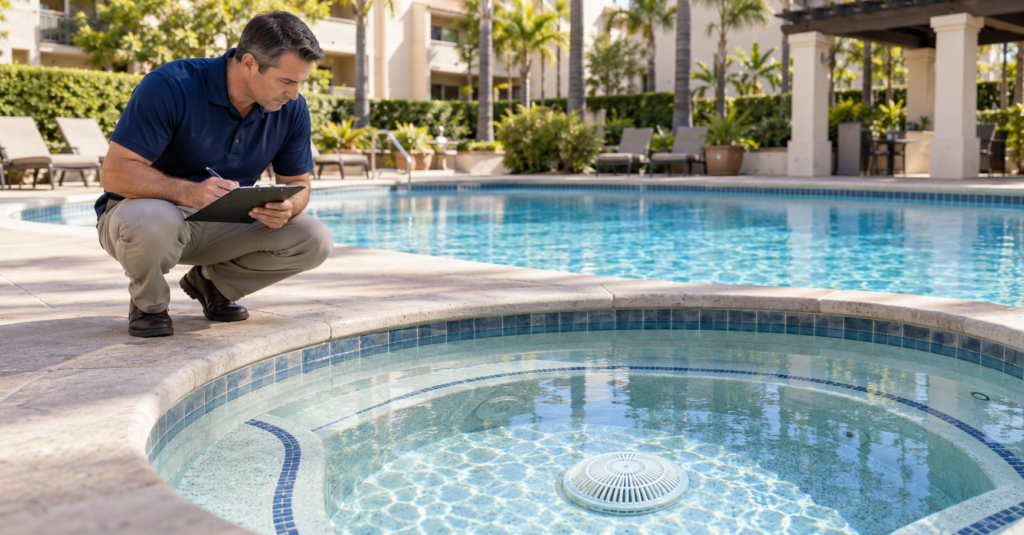
A pool can have clear water, a locked entrance, and a recently resurfaced deck while an important safety issue remains underwater. Drain covers have specific installation requirements and service limits that may not be apparent to residents or guests.
Irvine pool injuries involving a suction outlet can raise questions about replacement dates, equipment compatibility, and who maintained the system. Investigating those details requires more than photographing a damaged cover. The condition before the incident, the pool’s operating configuration, and the connection between the equipment and the injury all matter.
A Residents-Only Pool Can Still Be Regulated as a Public Pool
A key-card entrance does not necessarily place an apartment or condominium pool outside public-pool safety requirements.
Orange County’s Health Care Agency includes pools at apartments, condominiums, townhouses, hotels, and other shared facilities within its public-pool oversight. Its inspections address construction, operation, and water chemistry. Irvine residents can use the county’s pool safety resources to identify the agency responsible for this oversight.
“Public pool” in this regulatory context does not necessarily mean government-owned. That distinction becomes important when identifying the responsible parties and applicable claim procedures.
A backyard pool serving a single private residence may fall under different requirements. The investigation should establish the facility’s actual classification before applying a rule.
An Intact Cover May Have Reached Its Replacement Date
A cover does not have to be visibly broken before its service life becomes relevant.
The Consumer Product Safety Commission recommends replacing drain covers that have passed their marked expiration date, even if they otherwise meet the applicable standard. Its inspection checklist separately addresses physical condition and manufacturer-recommended lifespan. Those are different checks.
Orange County’s guidance calls for drain-cover documentation identifying the manufacturer and model, installation location, installation date, and service life. Those details help establish which component was installed and when replacement was due.
An invoice saying “pool repairs completed” may not answer whether the drain cover was replaced. Likewise, the date a pool was replastered does not, by itself, establish the age of every component.
The useful question is specific: what records connect the cover involved in the incident to its installation and replacement history?
A Replacement Cover Must Match the Installed System
A recently purchased cover can still require careful examination.
Orange County’s replaster guidance directs installers to follow manufacturer requirements concerning sump size, pipe orientation, and flow ratings. The sump is the space beneath the cover where water enters the suction plumbing. A replacement must be appropriate for that configuration.
CPSC guidance also calls for checking that the system’s maximum flow does not exceed the cover’s approved rating.
After an injury, a qualified examiner may need to compare the actual equipment with installation documents and operating settings. Relevant questions include whether the correct fastening components were used and whether later pump or plumbing changes affected the arrangement.
For example, a hypothetical maintenance file might show a cover replacement followed by a pump upgrade. That sequence would justify checking compatibility. It would not, without further analysis, establish that either change caused the injury.
Backup Protection Does Not Replace a Suitable Cover
Federal requirements address more than the presence of a grate.
CPSC’s drain-cover guidance explains that public pools and spas must have compliant anti-entrapment drain covers. Certain configurations, including a single blockable drain or multiple drains on the same plane less than three feet apart, also require a secondary anti-entrapment device or system.
A statement that “the pool has a safety shutoff” therefore leaves important questions unanswered. The investigation may need to establish what protection was required, what was installed, and whether it functioned.
CPSC also cautions that secondary systems should not be relied on as a reason to keep a pool operating while covers requiring replacement remain in use.
Responsibility Depends on Control, Conduct, and Causation
California premises-liability principles generally require reasonable care by people or entities owning, occupying, leasing, or controlling property. Relevant considerations include what they knew or should have known about a dangerous condition and their ability to address it.
For an Irvine apartment or HOA pool, a lawyer may investigate the roles of the property owner, association, management company, and maintenance contractor. Agreements, work orders, and communications can help explain who inspected equipment, approved repairs, and responded to complaints.
Hiring a contractor does not automatically resolve the property owner’s responsibilities. Equally, being named in a maintenance contract does not automatically make a contractor liable for every incident.
A premises claim must connect negligent use or maintenance of the property to actual harm. California’s jury instructions require the negligence to have been a substantial factor in causing that harm.
If evidence instead points to a manufacturing defect, defective design, or inadequate product warnings, a separate product-liability analysis may be appropriate.
The Records That Can Clarify What Happened
A useful evidence request identifies particular documents and physical components. Broad statements such as “the pool was always maintained” are difficult to evaluate without supporting records.
| Record or item | Question it may help answer |
|---|---|
| Installation invoice and model information | Which cover was installed, and when? |
| Maintenance logs and work orders | What inspections or repairs were recorded? |
| Prior complaints and management responses | Was a similar concern reported before the injury? |
| Inspection reports and correction notices | What conditions were identified, and what follow-up occurred? |
| Pump specifications and modification records | Did the operating system change after installation? |
| Incident reports, witness accounts, and video | What happened during the event and immediate response? |
These are investigative starting points, not a guarantee that every record exists or will be immediately available.
Ask counsel about preserving relevant equipment before it is discarded or subjected to destructive testing. Making the pool safe remains essential; photographs, identification, and coordinated handling can help document components removed during repairs.
Our guide to evidence that supports a personal injury case explains how medical records, witness information, and other documentation can work together.
Protect People Before Trying to Document the Hazard
Medical care and emergency assistance come first. In an emergency, call 911 and alert pool staff.
Do not enter the water to test suspected suction or remove a cover yourself. CPSC’s Pool Safely guidance advises against entering pools or spas with loose, broken, or missing drain covers and warns that suction can trap an adult.
Once immediate needs have been addressed, write down the location, time, witnesses, and what you personally observed. Distinguish observations from information someone else later supplied.
Report the incident to the operator and keep a copy of your communication. If photographs can be taken safely from an authorized location, preserve the original files. Do not recreate the incident or move equipment to produce a clearer picture.
Claim Deadlines Depend on Who Operated the Pool
California Courts lists a general two-year filing period for personal injury lawsuits. Exceptions can affect that calculation, including some cases involving minors or delayed discovery.
A government-owned or operated facility can introduce different requirements. A personal injury claim against a California public entity generally must first be presented to the appropriate agency within six months of the injury, subject to applicable exceptions. Separate lawsuit deadlines follow.
An incident report submitted to a lifeguard, manager, or insurer should not be assumed to satisfy a formal government claim requirement.
Because regulatory classification and ownership are different questions, determine who controlled the facility rather than relying on whether residents called it a “public” or “private” pool.
When to Contact a Lawyer
Seek legal advice promptly after a serious pool injury, particularly if equipment will be replaced, responsibility is disputed, or an insurer requests a settlement release.
A California personal injury lawyer can assess the parties involved, arrange appropriate evidence-preservation requests, and decide whether an aquatic-safety or engineering expert is needed. Counsel can also review medical documentation and losses such as treatment expenses or missed work.
Bring existing records rather than trying to conduct your own equipment inspection. A focused initial discussion should identify the suspected mechanism of injury, what evidence remains available, and which deadlines require immediate attention.
Note: This article provides general information about Irvine pool injuries and drain-cover safety. It is not legal advice and does not create an attorney-client relationship. Liability, equipment requirements, and filing deadlines depend on the facts and applicable law. Consult a California personal injury attorney about a specific incident.