
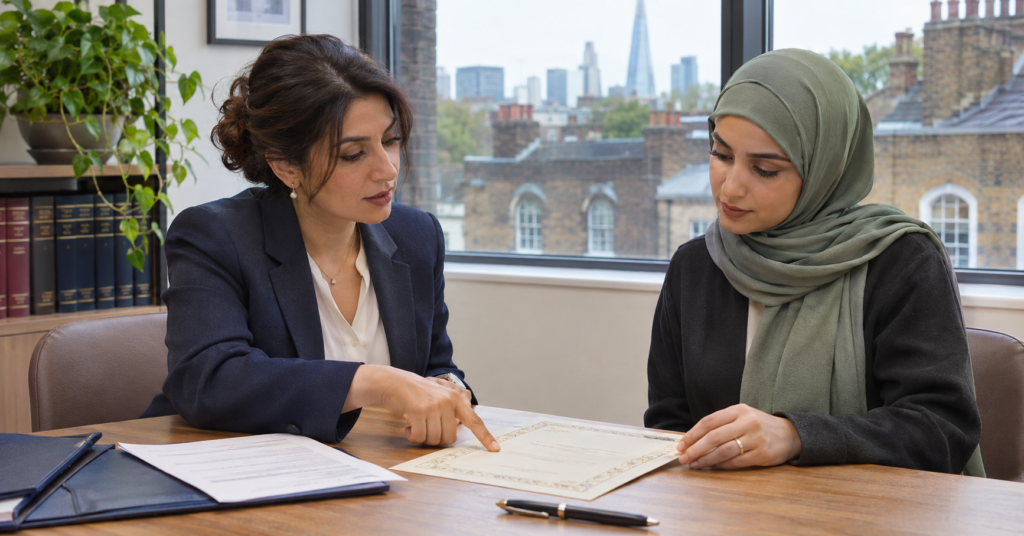
A nikah certificate may be among a couple’s most important family documents. Yet when a relationship ends, a solicitor may need further evidence before confirming whether the couple can use the divorce process in England and Wales.
Checking the legal status of London nikah marriages starts with where the ceremony happened and which legal requirements were followed. A religious wedding can create a legally recognised marriage. The word “nikah,” by itself, does not establish the answer.
Check What Happened at the English Ceremony
For a nikah performed in London, the investigation usually begins with the marriage formalities: notice, the venue’s registration for marriages, the authorised person or registrar, and the official records.
A building being used as a mosque does not, by itself, establish that it was registered for legal weddings. Equally, conducting the religious ceremony and being legally authorised to oversee marriage formalities are different roles.
Under the current system, relevant checks include whether the couple gave notice, whether the required official attended, and whether the marriage schedule was signed and returned for registration. Older ceremonies require examination of the rules and records applicable at that time.
The government’s guidance on religious wedding ceremonies explains the current arrangements. A separate civil ceremony is not universally necessary where the religious wedding itself meets the legal requirements.
Identify What Your Certificate Actually Records
Start by checking who issued each document. A certificate supplied by a religious organisation may record the nikah, while an official marriage certificate records an entry in the civil marriage register.
For an English marriage, a replacement official certificate can generally be requested through the General Register Office or the local register office where the marriage was registered.
London borough records can provide a useful starting point. For example, Tower Hamlets’ certificate guidance distinguishes legal religious ceremonies from Islamic ceremonies conducted without the required register-office preliminaries.
A missing certificate needs investigation. It could involve a lost copy, incorrect search details, incomplete registration, or a ceremony that never met the necessary legal requirements. Do not treat an unsuccessful search as a complete legal assessment.
Understand the Difference Between Void and Non-Qualifying
Marriage status is more complicated than deciding whether a certificate looks official. Three categories are particularly relevant:
| Classification | Practical significance |
|---|---|
| Valid marriage | Creates legal marital status and can support a divorce application where the other requirements are met. |
| Void marriage | Legally invalid, but a nullity order can provide access to matrimonial financial remedies. |
| Non-qualifying ceremony | Falls outside the statutory marriage framework and does not provide that route to divorce or nullity-based financial remedies. |
A voidable marriage is a further category: it remains valid unless annulled on a recognised ground.
The government’s explanation of current marriage law distinguishes these outcomes. Their boundaries require legal analysis; a paperwork problem does not automatically place a ceremony in one category.
What a London Court Case Shows
In HM Attorney General v Akhter and Khan [2020] EWCA Civ 122, the Court of Appeal considered a nikah held at a London restaurant.
The parties intended to have a legally compliant civil ceremony later, but it never happened. The court found that the nikah was a non-qualifying ceremony and overturned the earlier decision allowing a decree of nullity.
The judgment also rejected the argument that a planned future ceremony could change the legal effect of the ceremony that actually occurred. Its significance lies in the particular facts and missing formalities; it does not establish that all nikah marriages lack legal recognition.
Assess Overseas Nikahs Under the Correct Rules
A London resident may have married in Pakistan, Bangladesh or another country. Applying the English venue and notice requirements directly to that overseas ceremony can lead to the wrong conclusion.
Government guidance states that a foreign marriage is recognised in the UK if it was lawful where it took place and would be allowed under UK law. The assessment may require evidence of local marriage procedures and each person’s legal capacity to marry.
An ordinary foreign marriage is not registered again in the UK simply because the couple moves here. The absence of a British marriage certificate therefore does not, by itself, make it invalid.
Collect the original foreign certificate or registration extract and an appropriate translation. Explain any earlier marriages and how they ended. Where foreign law or documents are disputed, a solicitor may need specialist evidence before advising on recognition.
Keep Religious Divorce and Civil Divorce Separate
A religious divorce obtained in England does not itself terminate a legally recognised civil marriage. Section 44 of the Family Law Act 1986 generally requires a divorce obtained in the British Islands to come from a court of civil jurisdiction to be effective in UK law.
Someone may consequently need advice about both their religious position and their civil marital status. A religious document should not be treated as a substitute for the court’s final divorce order.
An overseas divorce raises a separate recognition question. Its effect can depend on the procedure used, validity under local law, and the parties’ connections with the relevant country. Some overseas divorces can be recognised; a blanket statement that every religious divorce is ineffective would be misleading.
Check that position before remarrying or describing yourself as legally divorced on official documents.
Consider Property and Children Through the Available Routes
A finding that no legally recognised marriage exists can substantially change the financial options. Living together for many years does not create a “common law marriage” in England and Wales.
However, the absence of matrimonial remedies does not automatically eliminate every possible claim.
Property disputes may turn on legal ownership, beneficial interests, trusts or agreements. Relevant evidence can include title documents, declarations of trust, purchase contributions and communications about ownership. These claims operate differently from a divorce court’s financial assessment.
Children’s financial needs also require separate consideration. Child maintenance arrangements and, where appropriate, applications under Schedule 1 to the Children Act 1989 may remain available to unmarried parents. Provision for a child is not equivalent to a former partner’s personal entitlement to spousal maintenance or pension sharing.
Prepare a Clear Timeline Before Seeking Advice
Organise the documents around the sequence of events. Include:
- The date, country and exact venue of each ceremony.
- Names and contact details for the officiant and witnesses.
- Religious certificates, marriage contracts and official registration documents.
- Notice confirmations and correspondence with registration authorities.
- Documents ending earlier marriages.
- Any later civil ceremony or overseas divorce paperwork.
Keep original documents and complete copies, including reverse pages, stamps and translations. Note differences in names, spellings and dates rather than correcting the originals yourself.
Messages about a proposed civil wedding may help explain what the couple understood. They should be identified as evidence of discussions, without presenting the planned event as something that actually occurred.
When to Contact a Lawyer
Contact a London family solicitor when a partner disputes the marriage’s legal status, an official record cannot be located, an overseas ceremony needs assessment, or separation discussions involve substantial property or pension interests.
Ask whether the solicitor has experience with marriage validity, nullity and international recognition. Explain the outcome you need: confirmation of status, advice about ending the relationship, or assessment of available financial claims.
Our general guide to questions to ask before hiring a divorce lawyer can help you prepare questions about experience, fees and communication.
Obtain advice before signing a settlement based on an assumption that you either have full spousal rights or no rights at all. Ask what further evidence is needed and which issues require a court determination.
Check Reform Headlines Against the Law in Force
The government consulted on changes to weddings law in 2026, including a proposed shift towards regulation centred on officiants. A consultation or reform announcement does not itself validate an earlier ceremony. Check enacted rules, commencement dates and any transitional provisions before relying on a reported change.
Note: This article provides general information about the law in England and Wales, not legal advice or a religious ruling. Marriage recognition depends on the ceremony, applicable law and evidence. Consult a qualified family solicitor about your circumstances.